
Before there were church buildings, there were homes—and within them, the first expressions of Christian community took shape.
The earliest followers of Jesus did not gather in dedicated sacred spaces. They met in homes—ordinary dwellings scattered across cities, towns, and rural settings throughout the Roman world. To understand the early church, we must first understand the homes in which it lived.
The Shape of a Roman Home
Homes across the Roman world varied widely depending on location, wealth, and local building traditions. In larger cities like Ephesus, some families lived in well-built urban homes organized around a central courtyard—spaces that brought light, air, and daily activity into the center of the house. These courtyard homes could accommodate gatherings and were well suited for hosting others.
But most people did not live in homes like these.
In crowded urban centers, many lived in insulae—multi-story apartment buildings that housed laborers and the working class. These spaces were smaller, often cramped, and less suited for large gatherings.
Outside the major cities, housing looked different again. In smaller towns and rural areas, homes were typically modest—stone or mud-brick structures with activity centered not inside a formal courtyard, but in outdoor spaces beside the home. Daily life often extended into these shared or open areas, where work, meals, and conversation naturally overlapped.
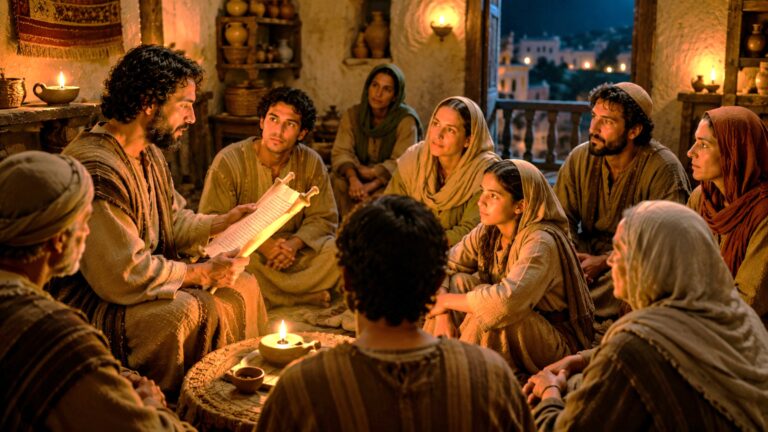
In Judea and the surrounding regions, homes often reflected local building traditions that differed somewhat from Greco-Roman cities. Stone houses were common, sometimes built in tiers along a hillside or organized across multiple levels. Many included upper rooms or rooftop spaces that could be used for gathering.
The Gospels and Acts give us glimpses of these settings. The home in Bethlehem where Jesus was born reflects a dwelling where living space and animal shelter were closely connected. In Jerusalem, an upper room provided space for Jesus and His disciples to share a final meal together—and later became a place where believers gathered in prayer. The same setting, or one like it, likely hosted the large group present at Pentecost.
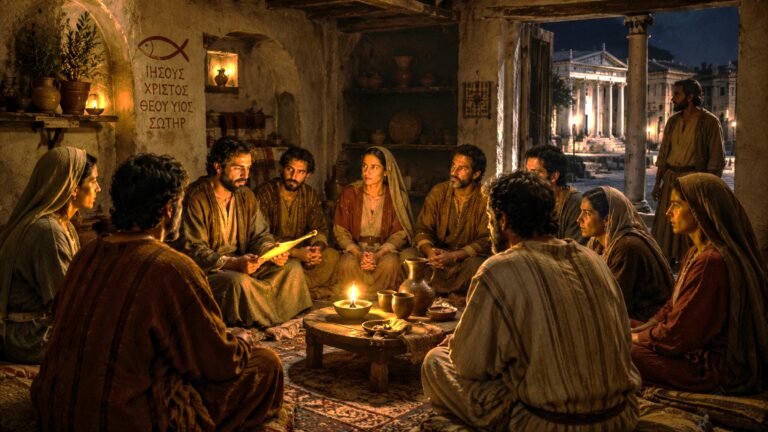
In The Vigil, we reflect this range of settings. Terrace House in Ephesus is an example of an urban courtyard home, while Mary’s House on Nightingale Mountain includes an outdoor space alongside the house where daily life unfolds. Though different in form, both reflect the kinds of environments where people gathered in the first century.
Across all these settings, one feature remained consistent: homes were not private, self-contained units as we often think of them today. They were active, shared spaces where family life, work, and social interaction overlapped. It was within these ordinary, varied environments that the early church first gathered.
The Household as a Social Unit
A “household” in the first century was more than a family. It included extended relatives, servants, laborers, and sometimes apprentices. All were considered part of a single social and economic unit under the authority of the head of the household.
This structure meant that when the message of Jesus entered a home, it often spread through the entire household. We see this pattern repeatedly in the book of Acts, where entire households respond together.
The household was not just a place of residence. It was a center of work, relationship, authority, and daily provision. When the early church took root in these spaces, it naturally became woven into the fabric of everyday life.
House Churches in Acts and the Letters of Paul
The New Testament offers several glimpses of these early gatherings. Believers met in homes to pray, share meals, and receive teaching. These were not formal services as we might recognize today. They were relational, participatory, and grounded in shared life.
We read of Lydia in Philippi, whose home became a gathering place for believers. Priscilla and Aquila hosted a church in their home. Paul’s letter to Philemon is addressed not only to an individual but to the church that met in his house.
These homes became centers of spiritual life—not because of their structure, but because of the people within them. Faith was expressed in conversation, hospitality, teaching, and shared meals.
The church did not need a building to exist. It needed people gathered in the name of Jesus.
Why the Church Grew in Homes
Homes provided what the early church needed most: access, relationship, and continuity with daily life. There were no barriers to entry, no requirement for formal space, and no separation between spiritual life and ordinary living.
Meeting in homes also allowed the message of Jesus to spread organically. As households came to faith, new centers of gathering emerged across cities and regions. The growth of the church followed the natural networks of relationships already in place.
This pattern also helps explain something we still see today. Many churches encourage small groups to meet in homes—not as a modern innovation, but as a return to an ancient practice. In smaller settings, relationships deepen, conversations open more freely, and faith becomes part of everyday life rather than something confined to a weekly gathering.
The early church reminds us that spiritual formation often happens best in close, shared spaces.
Why This Still Matters
It is easy to associate the church with buildings—sanctuaries, stages, and structured gatherings. Yet the first expressions of the church were far simpler and far more personal.
They unfolded around tables, in courtyards, and within the rhythms of daily life.
This does not diminish the value of larger gatherings. Rather, it reminds us that the foundation of the church has always been relational. The strength of the early church did not come from its structures, but from its people—and the homes in which they lived out their faith together.
Author Note
As we wrote about the world of the early church, we were continually struck by how ordinary these settings were. The same spaces used for meals, work, and rest became places where the Good News was shared and lived. It is a quiet reminder that faith has always taken root in the midst of everyday life.
Explore More
You can explore related posts across the remaining areas of the St. Hans blog: Nightingale Mountain Trilogy, Ministry & Church Leadership, Updates & Releases.
Written by D. D. Shiell — Authors of the Nightingale Mountain Trilogy