
The message of the gospel entered a world ordered by hierarchy, where freedom and bondage shaped daily life.
The Roman world of the first century was built on structures that most people simply accepted as part of life. Among these, slavery stood as one of the most visible and far-reaching realities.
It touched households, farms, workshops, and cities. It shaped relationships, labor, and identity. And it formed part of the social world into which the early followers of Jesus lived, worked, and gathered.
A World Where Slavery Was Common
Slavery in the Roman Empire was not rare or hidden. It was widespread and woven into everyday life.
In major cities, a significant portion of the population consisted of slaves. Some were captured in war. Others were born into slavery. Still others were sold due to debt or poverty.
Unlike later systems of race-based slavery, Roman slavery was not defined by ethnicity. A slave could come from nearly any region of the empire.
Yet this did not make it light or humane.
A slave was considered property under Roman law. Their legal standing was limited. Their freedom depended entirely on the will of their owner.
Household Slaves and Laborers
Not all slaves lived under the same conditions.
Some served within households—cooking, cleaning, managing accounts, or assisting in business matters. In certain cases, these individuals developed close proximity to family life and responsibility.
Others labored in fields, mines, or large agricultural estates, where conditions were often harsh and unrelenting.
Even within a single household, roles could vary widely. A skilled servant might oversee other workers, while another carried out the most basic tasks.
This range of experience reminds us that slavery in the Roman world was not a single uniform condition—but a broad system with many layers.
The Early Church Within This World
The early church did not exist outside this system. It grew within it.
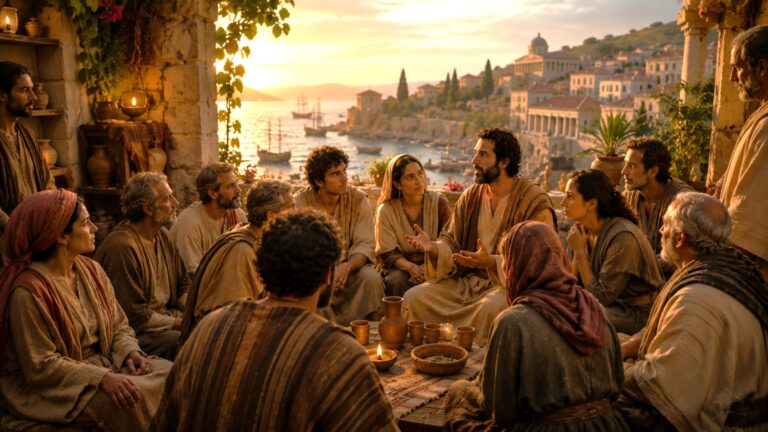
Gatherings in homes often included a mixture of people—household members, laborers, business owners, and slaves. They sat in the same rooms, shared the same meals, and listened to the same teachings.
This was not a political movement attempting to restructure society from the outside.
It was something quieter—and in many ways, more radical.
Within these gatherings, a new identity began to take shape. One that was not rooted in status, wealth, or position, but in belonging to Christ.
This did not erase social distinctions overnight. But it introduced a new way of seeing one another.
Philemon and a Personal Appeal
One of the clearest glimpses into this reality appears in Paul’s letter to Philemon.
A man named Onesimus, who had been enslaved, became a follower of Jesus and developed a close relationship with Paul. Paul then writes to Philemon, Onesimus’ master, asking him to receive Onesimus not simply as a servant, but as a brother.
The letter does not read like a command. It reads like an appeal.
It invites Philemon to reconsider the relationship—not through law or pressure, but through the lens of shared faith.
This moment does not dismantle the system outright. But it reveals something deeper beginning to take hold within it.
Why This Still Matters
It can be difficult to read about a world so structured by inequality.
And yet, this was the world into which the gospel first took root.
The early church did not begin in ideal conditions. It began among ordinary people living within imperfect systems—people learning, slowly, to see one another differently.
What emerged was not immediate social transformation, but a reordering of identity.
Over time, that reordering would carry consequences far beyond the walls of any single home.
But it began quietly—around tables, in households, among people who were learning what it meant to belong to one another in a new way.
Author Note
As we consider the world of the early church, we are reminded that faith often takes root within the realities people cannot easily change. What begins as a shift in how people see one another can, over time, reshape far more than they expect.
Explore More
You can explore related posts across the remaining areas of the St. Hans blog: Nightingale Mountain Trilogy, Ministry & Church Leadership, Updates & Releases.
Written by D. D. Shiell — Authors of the Nightingale Mountain Trilogy