What an ancient Jewish harvest festival and our modern Thanksgiving can tell us about blessings, memories, and the things we take for granted.
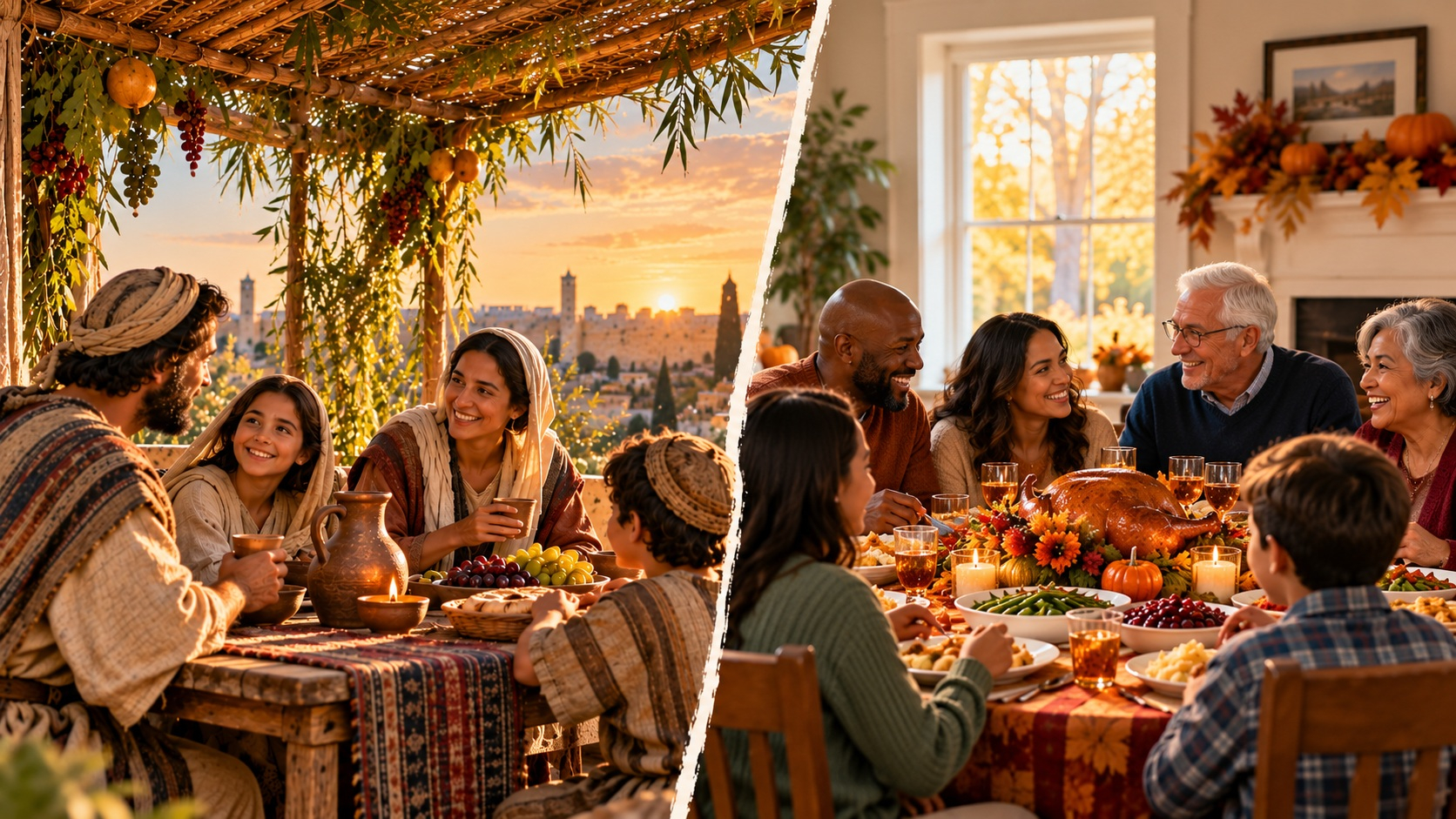
Think about the images we associate with Thanksgiving: fields of golden grain, pumpkins, baskets overflowing with produce, and tables laden with food. They are familiar and comforting, even though most of us haven’t harvested a field or gathered grapes from a vineyard.
We celebrate the harvest without actually doing much harvesting.
As it happens, that isn’t an entirely modern phenomenon.
In the first century, many Jewish families lived in cities such as Jerusalem, Alexandria, and Antioch. They were merchants, craftsmen, laborers, and shopkeepers. Their lives depended on agriculture, but their days weren’t necessarily spent working in the fields.
Yet the ancient harvest festivals remained an important part of their lives. One of the most interesting was Sukkot, the Festival of Booths.
A HARVEST FESTIVAL WITH A TWIST
Sukkot, also called the Feast of Tabernacles, was one of ancient Israel’s great annual celebrations.
It came after the harvest, when grain had been gathered and grapes pressed into wine. Deuteronomy 16:13–15 describes a joyful festival that included families, servants, foreigners, orphans, and widows.
There was plenty to celebrate. A good harvest meant food for the coming months and a measure of security for families whose lives depended on what the land produced.
But Sukkot included something rather unusual.
For seven days, the Israelites were instructed to live in temporary shelters, or booths, made from natural materials. Leviticus 23:39–43 explains that these shelters recalled the years their ancestors spent in the wilderness after leaving Egypt.
Imagine celebrating a successful harvest by moving out of your comfortable home and spending time in a simple shelter.
That contrast was part of the point.
The harvest was a blessing worth celebrating. The booths were a reminder that life had not always been so secure.
CITY PEOPLE AND COUNTRY TRADITIONS
By the time of Jesus and Paul, Jewish communities were scattered throughout the Roman world.
Many lived in busy cities, earning their living through commerce, skilled trades, and other occupations. They might purchase their bread from a baker rather than grow the grain themselves.
Nevertheless, they continued to celebrate festivals rooted in the agricultural year.
Some traveled to Jerusalem for Sukkot, while others observed the festival closer to home. The Gospel of John even describes Jesus attending the Festival of Booths in Jerusalem (John 7).
For these city dwellers, the festival was about more than crops. It connected them with their history, their faith, and the generations who had celebrated before them.
And it gave them an occasion to be thankful for blessings they might otherwise overlook.
OUR OWN THANKSGIVING TRADITIONS
There’s an interesting parallel with American Thanksgiving.
Our holiday has a different history, developing through colonial harvest celebrations, thanksgiving proclamations, and eventually becoming a national observance. We shouldn’t assume it descended directly from Sukkot.
Still, the similarities are worth noticing.
Most Americans no longer work in agriculture. We buy our groceries, often without knowing where the food was grown or how many people helped bring it to our tables.
Yet our Thanksgiving decorations still feature wheat, corn, pumpkins, and harvest baskets.
Perhaps these images remain meaningful because they remind us of something we rarely think about: how much of what we enjoy depends on people and circumstances beyond our immediate lives.
A harvest celebration doesn’t lose its meaning simply because we live in a city.
WHAT THE BOOTHS REMIND US
Of all the traditions associated with Sukkot, the temporary shelters may be the most thought-provoking.
They are a reminder that the Israelites’ ancestors once lived without permanent homes, settled fields, or the security that later generations enjoyed.
Even during a celebration of abundance, there was room for remembering harder times.
That strikes us as a particularly interesting approach to Thanksgiving.
It’s easy to appreciate a good meal, a comfortable home, or time with family. But remembering what life was like without some of those blessings—or recognizing that others still live without them—can make our gratitude more meaningful.
The booths brought that remembrance into the celebration itself.
WHY THIS STILL MATTERS
We live in a world where many of the things we depend upon happen out of sight.
Someone grows our food. Someone transports it. Someone keeps the electricity running and the water flowing. Most days, we give little thought to any of it.
Thanksgiving offers an opportunity to notice.
Sukkot and American Thanksgiving are distinct celebrations, with different histories and religious meanings. But both can remind us to appreciate what sustains our lives.
And Sukkot adds a particularly memorable thought: even when the harvest is plentiful, it is worth remembering the times when life was less certain.
Perhaps that’s a good way to approach Thanksgiving—not simply counting our blessings, but remembering why they matter.
AUTHOR NOTE
Our research into the world of the early Christians often leads us back to the Jewish traditions that shaped their lives. Sukkot is especially interesting because it combines a joyful harvest celebration with a reminder of the wilderness years.
For those of us celebrating Thanksgiving today, that combination of blessing, remembrance, and gratitude offers something worth thinking about.
EXPLORE MORE
Explore additional articles on the St. Hans Books blog about biblical history, Jewish traditions, and everyday life in the world of the early church.
Written by D. D. Shiell — Author of the Nightingale Mountain Trilogy
Frequently Asked Questions
What is Christian historical fiction?
Christian historical fiction is a genre that combines historical settings and storytelling with themes related to faith, spiritual life, and the lived experiences of people shaped by religious belief.
What are some popular settings for Christian historical fiction?
Common settings include biblical times, the Roman Empire, the early church, medieval Europe, the Reformation, and various periods of modern history.
Why do readers enjoy Christian historical fiction?
Many readers enjoy the combination of immersive history, emotionally grounded storytelling, spiritual themes, and meaningful human questions explored through another time and place.
What makes early church historical fiction unique?
Stories set in the early church world often combine Roman history, biblical context, cultural tension, persecution, travel, and the spread of Christianity throughout the Mediterranean world.
What is the Nightingale Mountain Trilogy about?
The Nightingale Mountain Trilogy is a Christian historical fiction series set in the first-century Roman world, exploring the lives of families and communities connected to the growth of the early church.