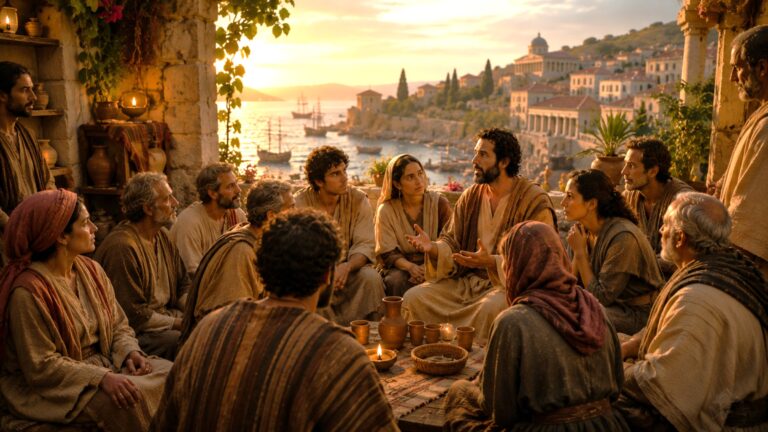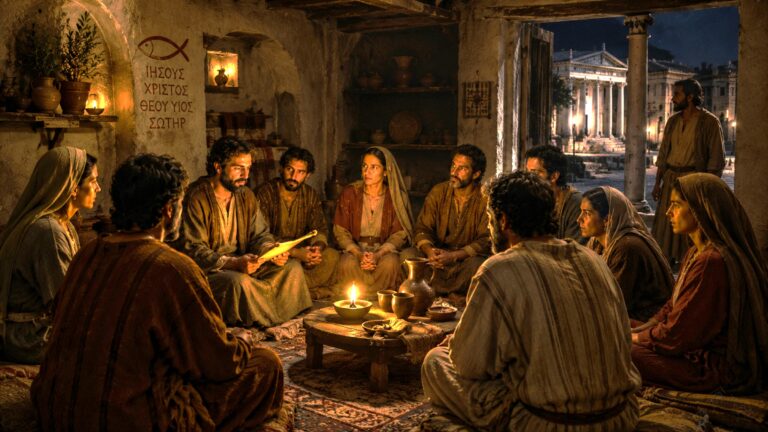
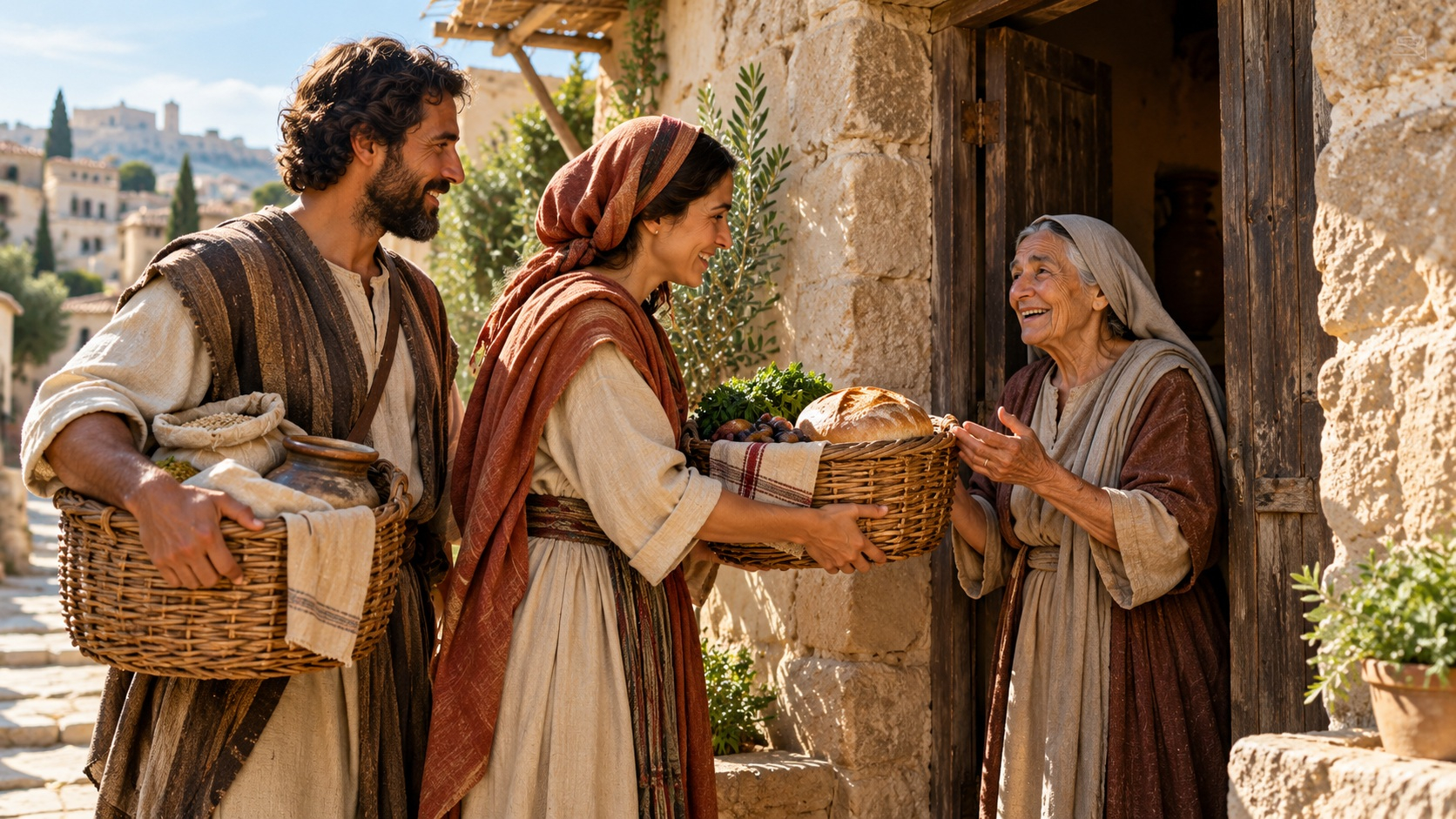
For the first Christians, generosity was part of learning how to live together as followers of Jesus.
When we think about giving in the church today, we often think first about financial contributions. Churches collect offerings to support their ministries, maintain buildings, pay staff, and help people in need. Giving is an established part of congregational life, and most Christians have some understanding of how it works.
For the earliest Christians, however, there were no established church budgets, permanent church buildings, or denominational organizations. Christian communities were still forming, often gathering in homes and learning what it meant to follow Jesus together. They had practical needs, and they had to decide how to respond to them.
The New Testament gives us several glimpses of how those first communities approached generosity. Their circumstances were different from ours, but the questions they faced remain familiar. Who needed help? Who was able to provide it? How much responsibility did Christians have for one another?
SHARING WHAT THEY HAD
The book of Acts describes a remarkable spirit of generosity among the first believers in Jerusalem. Acts 2 tells us that Christians shared their possessions and distributed resources according to people’s needs. Acts 4 describes believers who sold property and brought the proceeds to the apostles for distribution.
These passages have sometimes prompted debates about whether the earliest Christians practiced a form of communal ownership. The accounts certainly describe an unusual willingness to share resources, but Acts 5 also makes clear that believers retained authority over their own property. Peter tells Ananias that the property was his before it was sold and that the proceeds remained under his control afterward.
The emphasis was not simply on a particular economic arrangement. It was on the responsibility believers felt toward one another.
That responsibility had practical consequences. A widow without sufficient support needed food. A family experiencing hardship needed assistance. Someone with property or financial resources might be in a position to help.
The early Christians understood that belonging to a community of believers involved more than gathering for worship and teaching. They were also expected to notice and respond to the needs of others.
WHEN GOOD INTENTIONS NEEDED ORGANIZATION
As the Christian community in Jerusalem grew, generosity became more complicated.
Acts 6 describes a dispute involving the daily distribution of food to widows. Greek-speaking Jewish believers complained that their widows were being overlooked in comparison with those from the Hebrew-speaking community.
The problem was serious enough that the apostles called the believers together and arranged for seven men to take responsibility for the work.
This is an interesting episode because it shows that the early church did not always handle practical matters smoothly. Even among people committed to caring for one another, misunderstandings and unequal treatment could occur.
The solution required more than encouraging everyone to be generous. The community needed people who could administer assistance fairly and make sure that those who depended on it were not forgotten.
It is easy to imagine how such problems could arise in a growing community. People came from different backgrounds, spoke different languages, and had different social connections. Those who were well known might receive attention more readily than those who were less familiar.
The early church had to learn that caring for people required both compassion and responsible organization.
GIVING BEYOND THE LOCAL COMMUNITY
As Christianity spread beyond Jerusalem, giving became part of congregational life throughout the Roman world.
Paul’s letters show that he regarded generosity as an important expression of Christian faith. He encouraged believers to contribute according to their means, support those who were struggling, and take responsibility for one another.
One important example was a collection for impoverished believers in Jerusalem. In 1 Corinthians 16, Paul instructed the Corinthians to set aside money regularly so that their contribution would be ready when he arrived.
In 2 Corinthians 8, Paul also described the generosity of the Macedonian churches, whose members contributed despite experiencing hardship themselves. Their example demonstrated that generosity was not simply a matter of having substantial resources available.
The recipients of these contributions lived far away. Many of the Christians contributing to the collection had probably never met them.
That was a significant development. The early church was beginning to understand itself as a community extending beyond a single household, neighborhood, or city. Christians were being asked to recognize a responsibility toward fellow believers they might never meet. We will explore this collection more fully later in our November series.
GENEROSITY IN AN UNEQUAL WORLD
The Roman world was marked by substantial differences in wealth and social position. Some Christians owned homes large enough to accommodate gatherings. Others depended on daily wages or lived with little financial security. Widows, enslaved people, and those without strong family support could be particularly vulnerable.
These differences did not disappear when people became Christians.
In 1 Corinthians 11, Paul criticized the way some believers behaved when they gathered for a shared meal. Some had plenty to eat and drink, while others went hungry.
Paul considered this unacceptable in a community that claimed to belong to Christ.
His concern went beyond encouraging wealthy Christians to give something to poorer Christians. He wanted believers to recognize that their treatment of one another was connected to their understanding of the church itself.
The people gathered around the same table were supposed to regard one another as members of one body.
WHY THIS STILL MATTERS
There is a tendency to idealize the early church, especially when reading the descriptions of generosity in Acts. We can imagine a community in which everyone willingly shared, every need was met, and disagreements rarely occurred.
The New Testament presents a more complicated picture.
The first Christians could be remarkably generous, but they also struggled with fairness, economic differences, and the practical administration of assistance. Their communities were made up of ordinary people learning to live according to their faith.
That makes their experience particularly useful for Christians today.
Giving was not simply a matter of collecting money. It was connected to relationships, responsibility, and the recognition that the needs of others mattered. Sometimes generosity meant sharing possessions. Sometimes it meant contributing to a collection. Sometimes it meant organizing a fair distribution of food or confronting behavior that embarrassed poorer members of the congregation.
The circumstances have changed, but the underlying questions remain. How do we recognize genuine needs? How do we share resources responsibly? How do we make sure people are not overlooked? And how do we encourage generosity without turning it into an obligation imposed by pressure or guilt?
The early church did not leave us a complete financial system to copy. It did leave us examples of Christians trying to answer those questions as they learned what it meant to follow Jesus together.
Author Note
In writing the Nightingale Mountain Trilogy, we have tried to portray the early Christian communities as groups of real people living in the circumstances of the first-century Roman world. Their faith shaped how they treated one another, but it did not eliminate differences in wealth, background, or personal experience.
We find the New Testament’s accounts of generosity especially interesting because they show how Christian belief affected ordinary decisions about money, possessions, hospitality, and responsibility. Those practical aspects of community life help us understand the world in which the first followers of Jesus lived.
Featured Reading
If you enjoy exploring the historical world behind the New Testament, we invite you to continue the journey through the Nightingale Mountain Trilogy. The novels bring to life the people, places, and everyday realities of the first-century church, where history and faith meet through story.
Explore More
You can explore related posts across the remaining areas of the St. Hans blog: Nightingale Mountain Trilogy, Ministry & Church Leadership, Updates & Releases.
Written by D. D. Shiell — Author of the Nightingale Mountain Trilogy
Frequently Asked Questions
What is Christian historical fiction?
Christian historical fiction is a genre that combines historical settings and storytelling with themes related to faith, spiritual life, and the lived experiences of people shaped by religious belief.
What are some popular settings for Christian historical fiction?
Common settings include biblical times, the Roman Empire, the early church, medieval Europe, the Reformation, and various periods of modern history.
Why do readers enjoy Christian historical fiction?
Many readers enjoy the combination of immersive history, emotionally grounded storytelling, spiritual themes, and meaningful human questions explored through another time and place.
What makes early church historical fiction unique?
Stories set in the early church world often combine Roman history, biblical context, cultural tension, persecution, travel, and the spread of Christianity throughout the Mediterranean world.
What is the Nightingale Mountain Trilogy about?
The Nightingale Mountain Trilogy is a Christian historical fiction series set in the first-century Roman world, exploring the lives of families and communities connected to the growth of the early church.